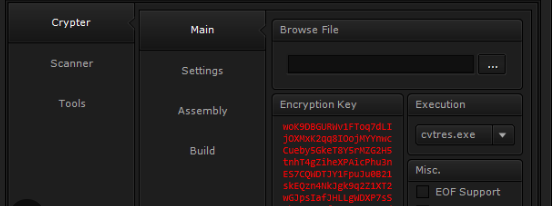
0 Crypter
Cybercriminals continue to leverage advanced 0 Crypter to bypass security measures, with newer variants becoming more sophisticated in their evasion techniques. These tools play a critical role in modern cyberattacks by enabling malware to remain undetected long enough to compromise systems, exfiltrate data, or establish persistent access. As endpoint detection solutions improve, crypters evolve in parallel, incorporating novel anti-analysis methods and leveraging legitimate system processes to conceal malicious activity. Their widespread availability in underground markets has made them a go-to solution for attackers deploying ransomware, spyware, and banking trojans.
This software is a next generation crypter designed to obfuscate malicious executables, making them resistant to static and dynamic analysis. It employs multiple layers of encryption and runtime manipulation to ensure that payloads evade detection by security products. Typically used by threat actors to distribute Remote Access Trojans (RATs), infostealers, and ransomware, it also includes features to bypass modern EDR (Endpoint Detection and Response) solutions. While primarily abused by malicious actors, red teams may also use similar tools to test defensive measures in controlled environments.
Key Features of 0 Crypter
| Feature | Description |
| Multi-Stage Encryption | Uses layered encryption (AES, ChaCha20) combined with custom XOR obfuscation. |
| EDR Evasion | Bypasses memory scanning and API hooking used by advanced security tools. |
| Reflective Loading | Executes payloads directly from memory without dropping files to disk. |
| Polymorphic Engine | Dynamically alters code structure to avoid signature-based detection. |
| Syscall Hijacking | Uses direct system calls to bypass user-mode monitoring. |
| Anti-Forensics | Clears execution artifacts to hinder post-compromise analysis. |
How 0 Crypter Works
The crypter follows a carefully orchestrated process to ensure stealthy payload delivery:
- Payload Preparation
- The original malware is first compressed and encrypted using a combination of algorithms.
- The crypter then modifies the executable’s Portable Executable (PE) structure, stripping or altering identifiable headers to evade static analysis.
- Stub Generation & Anti-Analysis Measures
- A polymorphic stub is generated, which contains the decryption routine. Each stub varies slightly in structure to prevent detection based on signatures.
- Before execution, the stub performs several checks to avoid analysis:
- Debugger Detection – Scans for attached debuggers.
- Sandbox Evasion – Checks system uptime, core count, and virtualization artifacts.
- EDR/Security Product Detection – Identifies security tools by scanning loaded modules or process names.
- Execution & Memory Injection
- The stub decrypts the payload in memory and employs Reflective DLL Injection or Process Hollowing to execute it within a legitimate process.
- To further evade behavioral monitoring, the payload may use:
- Direct Syscalls – Bypasses user-mode API hooks by directly invoking kernel-mode system calls.
- API Unhooking – Removes security product hooks from critical Windows Application Programming Interfaces (APIs).
- Persistence & Cleanup
- The payload establishes persistence via methods such as:
- WMI Event Subscriptions – Triggers execution based on system events.
- Trampoline Scheduled Tasks – Uses benign-looking task names to avoid detection.
- Post-execution, the crypter clears traces by:
- Overwriting memory artifacts.
- Deleting temporary files (if any were dropped).
- Spoofing parent process IDs to mislead forensic investigations.
- The payload establishes persistence via methods such as: