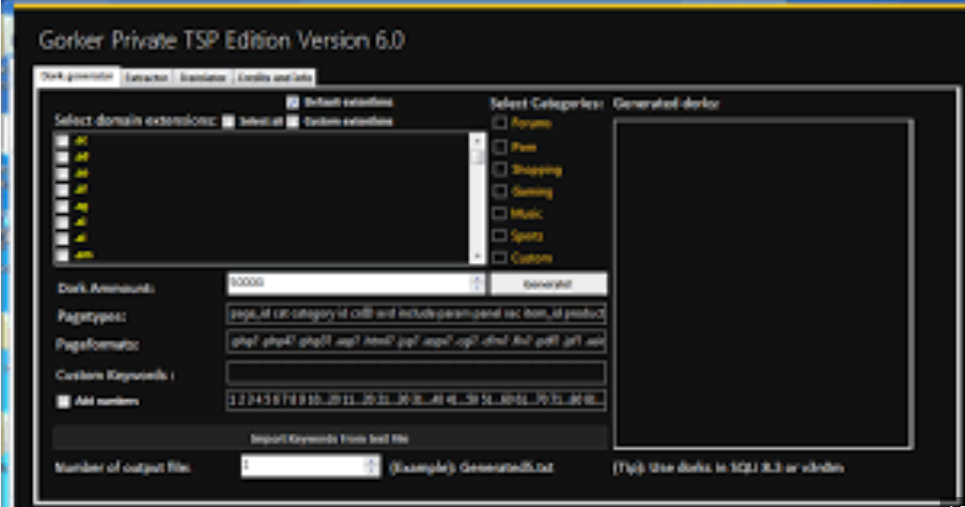
Gorker Private TSP Edition 6.0
In the evolving landscape of cyber threats, specific tools have gained notoriety for their role in facilitating sophisticated attacks. One such tool, often referred to in cybersecurity circles, is a remote access trojan (RAT) that enables attackers to gain persistent control over compromised systems. Its modular design and stealth capabilities make it a favoured choice among threat actors for espionage, data theft, and delivering secondary payloads. As cybercriminals continue to refine their tactics, understanding how such tools operate is critical for defenders to mitigate risks effectively.
Download Link 1
Download Link 2
Download Link 3
Download Link 4
Gorker Private TSP Edition 6.0 software is a malicious program designed to provide unauthorized remote access to a victim’s system. Typically distributed through phishing emails, malicious downloads, or exploit kits, it operates covertly to avoid detection. Once installed, it allows attackers to execute commands, exfiltrate data, and deploy additional malware. Its primary uses include corporate espionage, credential theft, and as a delivery mechanism for ransomware or other destructive payloads.
Key Features of Gorker Private TSP
| Feature | Description |
| Stealth Mechanisms | Uses process injection and evasion techniques to avoid detection by security tools. |
| Modular Architecture | Allows attackers to load plugins for expanded functionality dynamically. |
| Persistence | Establishes long-term access via registry modifications or scheduled tasks. |
| Data Exfiltration | Encrypts and transfers stolen data to command-and-control (C2) servers. |
| Keylogging | Captures keystrokes to harvest credentials and sensitive information. |
| Screen Capture | Takes screenshots to monitor user activity. |
| C2 Communication | Uses encrypted protocols (e.g., HTTPS or custom) to communicate with attackers. |
How the Gorker Private TSP Works
Infection and Execution
Gorker Private TSP Edition 6.0 typically infiltrates a system through social engineering (e.g., disguised as a legitimate file) or exploits vulnerabilities in software or operating systems. Once executed, it deploys several techniques to establish persistence and evade detection:
- Process Injection: It injects its code into legitimate processes (e.g., explorer.exe) to mask its activity.
- Persistence Mechanisms: It may create registry entries or scheduled tasks to ensure it runs after system reboots.
- Anti-Analysis Checks: It checks for virtual machines, debuggers, or security tools before activating to avoid sandbox detection.
Communication with Command-and-Control (C2)
The malware communicates with a Command and Control (C2) server to receive instructions and exfiltrate data. It often uses:
- Encrypted Channels: HTTPS or custom encryption to obscure traffic.
- Domain Generation Algorithms (DGAs): To dynamically generate C2 server addresses, making takedowns tricky.
Payload Delivery and Functionality
Once active, the software performs various malicious activities based on the attacker’s commands:
- Data Theft: Searches for and exfiltrates files, credentials, or clipboard data.
- Remote Control: Enables attackers to execute shell commands, manipulate files, or take over the system.
- Secondary Payloads: Downloads additional malware, such as ransomware or spyware, to escalate the attack.
By combining these techniques, the software maintains a strong foothold in compromised systems while remaining undetected. Understanding its operation is essential for developing effective detection and mitigation strategies.
![Work With Dorks [DORK’s Generator]-Dork Generator](https://blackhatus.com/wp-content/uploads/2025/07/Work-With-Dorks-DORKs-Generator-Dork-Generator-1.png)