HACK PACK Crypters, Binders, Keyloggers and more
In today’s evolving threat landscape, all-in-one HACK PACK have become a favored weapon for cybercriminals seeking to maximize their impact while minimizing technical barriers. These Swiss Army knife-style packages combine multiple malicious capabilities into unified platforms, enabling attackers to execute sophisticated campaigns with alarming efficiency. By integrating crypter, binder, and keylogger functionalities with automated deployment systems, these toolkits have significantly lowered the barrier to entry for cybercrime while simultaneously increasing the success rates of attacks. Their modular design and user-friendly interfaces make them particularly dangerous, as they empower even novice threat actors to conduct advanced attacks ranging from credential theft to ransomware deployment across both enterprise networks and individual targets.
Download Link 1
Download Link 2
Download Link 3
Download Link 4
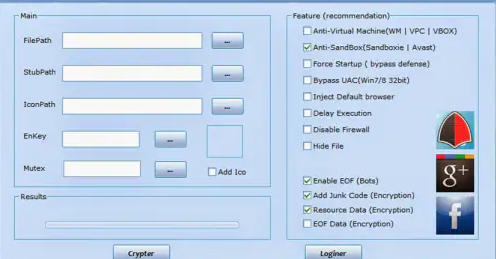
This comprehensive malicious toolkit provides end-to-end attack capabilities through a single, integrated platform designed for simplicity and effectiveness. It combines multiple offensive security tools with an intuitive workflow that guides users through each stage of an attack chain. Cybercriminals primarily leverage this software to create undetectable malware variants, bundle malicious payloads with legitimate applications, and monitor victim activity through various surveillance methods. The toolkit’s popularity stems from its ability to bypass modern security controls while requiring minimal technical expertise, making it particularly prevalent in credential harvesting operations, financial fraud schemes, and targeted espionage campaigns against both corporate and individual targets.
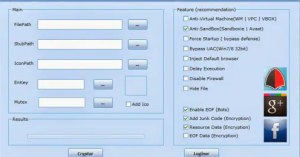
Key Features
| Feature | Description |
| Polymorphic Crypter | Multi-layer encryption with FUD (Fully Undetectable) capabilities |
| Intelligent Binder | Seamless malware integration with legitimate executables |
| Stealth Keylogger | Comprehensive input capture with form-grabbing technology |
| Anti-Analysis Suite | Advanced sandbox and virtual machine detection |
| Payload Generator | Unified interface for creating multiple malware types |
| Traffic Obfuscation | C2 communications disguised as legitimate cloud traffic |
| Self-Cleanup | Automatic removal of forensic evidence post-execution |
How HACK PACK Works
The toolkit orchestrates attacks through an automated, multi-phase process:
- Payload Preparation Phase
- Users select from various malware templates (RATs, infostealers, cryptominers)
- The crypter module applies sophisticated obfuscation:
- AES-256 encryption for core payload protection
- Polymorphic code generation for unique variants
- PE header manipulation to evade static analysis
- The binder merges payloads with legitimate host files:
- Preserves original application functionality
- Implements thread hijacking for stealth execution
- Maintains authentic digital signatures when possible
- Delivery & Execution Phase
- Generates customized infection vectors:
- Weaponized documents with macro triggers
- Compromised software installers
- Fake system utilities
- Implements advanced execution techniques:
- Process hollowing (replacing legitimate process memory)
- DLL sideloading (exploiting trusted application dependencies)
- COM hijacking (manipulating Windows component objects)
- Post-Infection Operations
- The keylogger module activates with multiple surveillance methods:
- Kernel-level keyboard monitoring
- Web form data interception
- Periodic screen capture functionality
- Establishes persistence through:
- Scheduled tasks masquerading as system processes
- Registry modifications in obscure locations
- Service installation with deceptive names
- Data Exfiltration Phase
- Utilizes multiple redundant communication channels:
- HTTPS tunnels mimicking browser traffic
- DNS tunneling for restricted environments
- Cloud storage APIs blending with legitimate traffic
- Implements data compression and strong encryption pre-transmission
- Automatically purges temporary components post-exfiltration