HVNC Tinynuke 2024
In the evolving landscape of cyber threats, remote access tools—both legitimate and malicious—play a significant role in modern attacks. One such tool, often referred to in cybersecurity circles, is the “HVNC Tinynuke 2024,” a sophisticated piece of malware designed to provide attackers with stealthy, persistent control over compromised systems. Unlike traditional Remote Access Trojans (RATS), this tool employs advanced techniques to evade detection while enabling unauthorised access, data exfiltration, and further exploitation. Its emergence highlights the growing trend of malware leveraging hidden virtual network computing (HVNC) to operate discreetly within targeted environments.
Download Link 1
Download Link 2
Download Link 3
Download Link 4
This software is a modular malware framework primarily used for covert remote administration. It enables attackers to interact with a victim’s machine as if they were physically present, while avoiding detection by running in a concealed desktop environment. Typical uses include credential theft, surveillance, lateral movement within networks, and deploying secondary payloads such as ransomware or spyware. Due to its stealth capabilities, it is often employed in targeted attacks against businesses, financial institutions, and high-value individuals.
Key Features of HVNC Tinynuke 2024
| Feature | Description |
|---|---|
| Hidden Desktop | Operates in a virtual desktop that is invisible to the user, allowing for undetected activity. |
| Persistence Mechanisms | Maintains long-term access via registry modifications, scheduled tasks, or DLL injection. |
| Credential Harvesting | Captures keystrokes, clipboard data, and authentication tokens from memory. |
| Process Injection | Executes malicious code within legitimate processes to evade endpoint detection. |
| Network Propagation | Scans and spreads across connected systems using stolen credentials or exploits. |
| Encrypted C2 Communication | Uses secure channels (e.g., HTTPS, WebSockets) to communicate with attacker servers. |
How HVNC Tinynuke 2024 Works
The malware operates in multiple stages, beginning with initial infection and culminating in complete system control. Below is a breakdown of its functionality:
Delivery and Execution
The payload is typically delivered via phishing emails, malicious attachments, or exploit kits. Once executed, it injects its code into a trusted system process to avoid suspicion. Some variants use fileless techniques, residing solely in memory to bypass traditional antivirus scans.
Establishing Persistence of HVNC Tinynuke 2024
To ensure it survives reboots, the malware modifies registry keys, creates scheduled tasks, or installs a malicious service. Some versions use DLL sideloading, where a legitimate application is tricked into loading a malicious DLL.
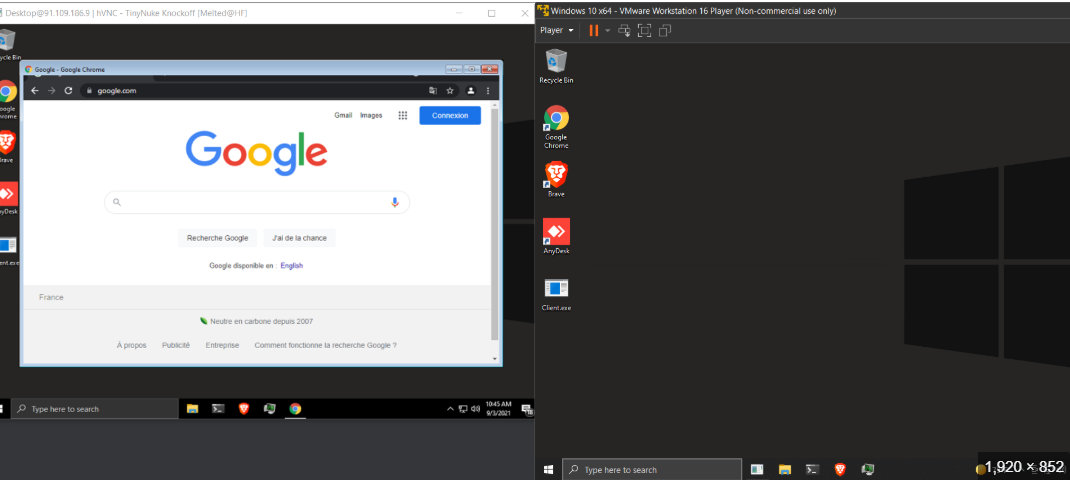
Hidden Desktop Operation
The malware creates a virtual desktop separate from the user’s active session. All malicious activities (e.g., browsing files, running commands) occur in this hidden environment, making them invisible to the victim.
Credential Theft and Lateral Movement
Using keyloggers, memory scrapers, or API hooks, the malware harvests credentials from browsers, Active Directory, or credential managers. These stolen credentials are then used to move laterally across the network, often via Remote Desktop Protocol (RDP) or Server Message Block (SMB) protocols.
Command and Control (C2) Communication
The malware communicates with attacker-controlled servers using encrypted channels, receiving commands and exfiltrating data. Advanced variants utilise domain generation algorithms (DGAS) to switch C2 servers, making takedowns challenging in a dynamic manner.