RDP ForcerX 1.5
In the age of remote work and cloud-based infrastructure, securing Remote Desktop Protocol (RDP) services is critical. RDP ForcerX 1.5 is a high-performance penetration testing tool designed to evaluate the strength of RDP login credentials. Whether you’re conducting internal audits or authorized penetration tests, this tool provides a controlled and efficient way to detect weak RDP configurations before malicious actors can exploit them.
Download Link 1
Download Link 2
Download Link 3
Download Link 4
What is RDP ForcerX 1.5?
RDP ForcerX 1.5 is an advanced brute-force tool that automates the process of testing username and password combinations against RDP servers. Designed for ethical hacking and network auditing, it helps cybersecurity professionals discover vulnerabilities, enforce password policies, and strengthen remote access points. With multi-threaded execution and support for custom configurations, it’s ideal for both enterprise and educational environments.
Key Features
| Feature | Description |
|---|---|
| Multi-Threaded Attacks | Performs simultaneous brute-force attempts to maximize speed and efficiency. |
| Custom Wordlist Support | Allows use of personalized dictionaries for targeted password attacks. |
| IP Range Scanning | Automatically scans a list of IPs to find exposed RDP services. |
| Proxy & VPN Integration | Routes connections through proxies or VPNs for anonymity and geolocation control. |
| Session Save & Resume | Pause and resume attacks without restarting, ideal for long-term testing. |
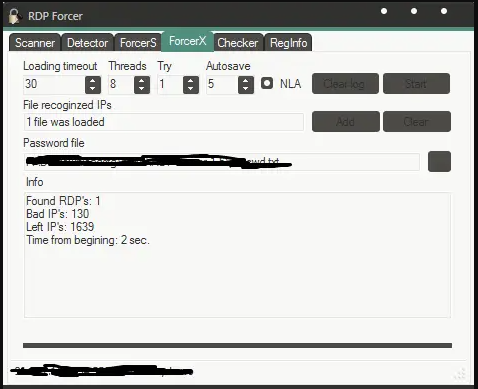
| User-Friendly GUI | Simplifies attack configuration with a clean and intuitive interface. |
| Logging & Reporting | Generates detailed logs of all attempts, successes, and server responses. |
| Delay & Speed Controls | Customize connection delay and attack speed to bypass detection mechanisms. |
| Credential Validation | Verifies successful login attempts and highlights potentially weak accounts. |
Why Use RDP ForcerX 1.5?
✅ Proactively Identify Weak RDP Credentials – Before attackers do.
✅ Support Security Compliance – Enforce organizational password policies.
✅ Train Cybersecurity Teams – Educate teams on real-world RDP attack scenarios.
✅ Reduce Attack Surface – By identifying and securing vulnerable endpoints.
✅ Non-Destructive Testing – When used ethically, it provides value without compromising systems.