Xenos Grabber 2025
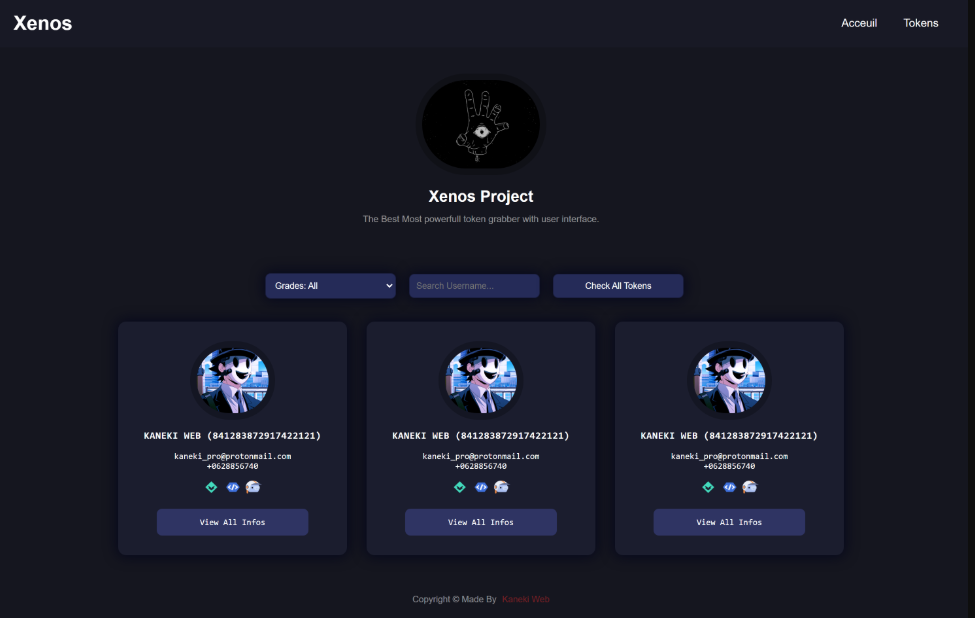
Information stealers have become one of the most pervasive threats in the cybercrime landscape, with attackers constantly developing more sophisticated tools to harvest sensitive data. The Xenos Grabber 2025 represents a new generation of malware designed to silently collect and exfiltrate valuable information from compromised systems. Unlike traditional stealers that focus on a single data type, this malware combines multiple harvesting techniques into a single package, targeting everything from saved credentials to cryptocurrency wallets. Its modular architecture and evasion capabilities make it particularly dangerous, allowing attackers to customize payloads based on their objectives while avoiding detection by security software. The availability of cracked versions in underground forums has further increased its adoption among cybercriminals of varying skill levels.
Download Link 1
Download Link 2
Download Link 3
Download Link 4
This software is an advanced information-stealing malware that specializes in comprehensive data collection from infected systems. It operates as a standalone executable or injectable module, capable of harvesting credentials, cookies, browsing history, cryptocurrency wallets, and other sensitive information. The malware is typically distributed through social engineering tactics, such as fake software cracks, game cheats, or malicious email attachments. Once installed, it runs silently in the background, collecting data and transmitting it to attacker-controlled servers. The stolen information is often used for financial fraud, identity theft, or sold on dark web marketplaces. Its flexible design allows attackers to enable or disable specific stealing modules depending on their target.
Key Features
| Feature | Description |
| Credential Harvesting | Extracts saved passwords from browsers, email clients, and FTP software |
| Cookie Theft | Steals browser session cookies for account hijacking |
| Cryptocurrency Targeting | Scans for and steals wallet files and clipboard cryptocurrency addresses |
| Form Grabbing | Captures form submissions (logins, credit card details) in real-time |
| Screen Capture | Takes periodic screenshots of user activity |
| Process Injection | Injects into legitimate processes to evade detection |
| Anti-Analysis | Detects virtual machines, sandboxes, and debugging tools |
| Persistence | Maintains access through registry modifications and startup entries |
How Xenos Grabber 2025 Works
1. Distribution and Infection
The malware employs multiple delivery methods:
- Fake Software Bundles: Distributed as cracks, keygens, or pirated software
- Phishing Campaigns: Malicious email attachments disguised as invoices or documents
- Social Engineering: Promoted as game mods or cheat tools in gaming communities
- Exploit Kits: Delivered through compromised websites targeting browser vulnerabilities
2. Initial Execution and Evasion
Upon execution, the malware performs several preparatory steps:
- Environment Checks: Scans for virtualization tools, security products, or analysis environments
- Persistence Setup:
- Creates registry run keys (HKCU\Software\Microsoft\Windows\CurrentVersion\Run)
- Adds scheduled tasks for periodic execution
- Copies itself to hidden system directories
- Process Injection: Injects malicious code into trusted processes like explorer.exe or chrome.exe
3. Data Harvesting Process
The stealer modules activate sequentially:
Browser Data Extraction
- Targets Chrome, Firefox, Edge, and other popular browsers
- Decrypts and exports saved credentials from password managers
- Collects autofill data, browsing history, and download records
- Steals session cookies to maintain access to logged-in accounts
System Information Collection
- Gathers hardware details, installed software, and network configuration
- Captures screenshots at regular intervals
- Logs clipboard contents for cryptocurrency address replacement
Cryptocurrency Theft
- Scans for wallet files (Electrum, Exodus, MetaMask, etc.)
- Monitors clipboard for cryptocurrency addresses to perform swapping attacks
- Checks for cryptocurrency-related browser extensions
Additional Modules
- FTP client credential harvesting (FileZilla, WinSCP)
- Email client data extraction (Outlook, Thunderbird)
- Discord token stealing for account takeover
4. Data Exfiltration
Collected information is packaged and transmitted:
- Compression: Data is compressed and encrypted before transmission
- C2 Communication: Uses multiple channels:
- HTTP/HTTPS requests to attacker-controlled servers
- Telegram bot APIs for stealthy data transfer
- Discord webhooks for small payloads
- Fallback Methods: May use DNS tunneling or encrypted email if primary channels fail
5. Cleanup and Persistence
- Some variants attempt to remove traces of initial infection
- Maintains persistence through multiple mechanisms
- Can download and execute additional payloads as needed