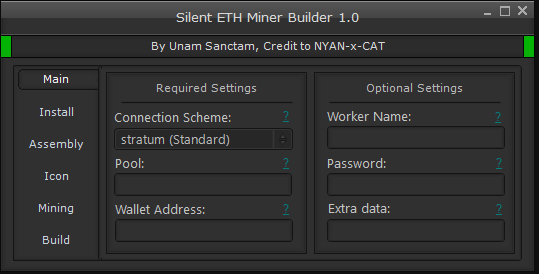
Silent ETH Miner v1.6.0
The cryptocurrency mining landscape has seen a surge in malicious cryptojacking attacks, with Silent ETH Miner v1.6.0 emerging as a particularly stealthy and efficient threat in modern cyberattacks. This sophisticated mining malware demonstrates how cybercriminals are exploiting system resources for unauthorized cryptocurrency mining without user consent. Silent ETH Miner v1.6.0 has been actively used in attacks against both individual users and enterprise networks, showcasing its ability to operate undetected while generating profits for attackers. Its low-profile design and advanced evasion techniques make it a significant concern in today’s cybersecurity landscape, where such hidden mining operations can cause substantial performance degradation and increased energy costs for victims.
Download Link 1
Download Link 2
Download Link 3
Download Link 4
What is the Silent ETH Miner
This software is a specialized cryptocurrency mining tool designed to secretly utilize a victim’s computing resources to mine Ethereum (ETH) without their knowledge. Unlike legitimate mining software, it operates covertly in the background, hiding its presence from users and security tools. The malware is typically distributed through malicious email attachments, compromised websites, or bundled with pirated software. Once installed, it connects to a mining pool controlled by attackers and uses the infected system’s CPU and GPU resources to generate cryptocurrency revenue. Cybercriminals primarily use it to create large-scale botnets of infected devices, collectively generating substantial profits while avoiding detection.
Key Features
| Feature | Description |
| Stealth Mining | Operates silently in the background without user notification |
| CPU/GPU Utilization | Maximizes mining efficiency by leveraging all available processing power |
| Auto-Configuration | Automatically connects to attacker-controlled mining pools |
| Process Injection | Runs within legitimate processes to evade detection |
| Persistence | Maintains access through registry modifications and scheduled tasks |
| Network Proxy | Route traffic through legitimate services to avoid detection |
| Resource Throttling | Dynamically adjusts CPU usage to avoid performance alerts |
| Anti-Analysis | Detects and exits virtualized or monitored environments |
How the Silent ETH Miner Works
The malware employs a sophisticated infection chain designed for maximum mining efficiency while maintaining stealth:
1. Delivery & Infection
Initial compromise typically occurs through:
- Phishing emails with malicious Office documents containing macros.
- Drive-by downloads from compromised websites.
- Trojanized software bundles (cracks, pirated games).
The infection process:
- Drops the mining payload in the system temp folders.
- Modifies system files to hide malicious processes.
- Disables security alerts related to resource usage.
2. Mining Operations
Once active, the malware:
- Analyzes hardware to determine optimal mining configuration.
- Connects to mining pools using attacker credentials.
- Distributes workload across CPU and GPU cores.
- Implements dynamic throttling to avoid detection:
- Reduces activity when a user is active.
- Maximizes mining during idle periods.
3. Persistence & Evasion
To maintain long-term operation:
- Creates scheduled tasks for automatic restart.
- Uses process hollowing to hide in svchost.exe.
- Implements rootkit techniques to conceal network traffic.
- Regularly updates the configuration from C2 servers.
4. Profit Generation
Mined cryptocurrency is:
- Automatically deposited into attacker wallets.
- Converted to privacy coins for laundering.
- Distributed across multiple addresses to avoid tracing.